Systems, Structure, and Creative Freedom
AI-assisted writing. The original ideas and experiences are mine.

Why Creativity Needs Rules
When I was younger, I had more ideas than I knew what to do with. They felt beautiful in my head, then scattered before I could make anything from them. I learned to build walls around the work, and the walls gave me focus. Systems gave that restlessness somewhere to go.
As a young musician, I could choose from what felt like endless options. Systems in music and daily life gave me a safe place to play. I thought of them as a sturdy sandbox: enough room to experiment without letting every idea spill out and disappear.
Composing in Miniatures
The blank page used to make composing feel enormous. I learned to trick my brain: like Schönberg with his miniatures, I'd break the goal into five small pieces instead of imagining a whole symphony. I'd write one musical snippet, then another. Soon I had a collection, and finishing no longer felt so distant.
My composition, These/These, grew from that process. The melody arrived as a spark I didn't want to lose. The systems around it helped me keep going without crowding it. The finished piece felt strong and left the melody room to breathe—a balance I was proud of.
The Power of the Grid
My obsession with structure followed me beyond music. I started seeing grids everywhere: in music notation, the clean lines of typography, the way a well-designed page guides the eye, and even the way I arrange thoughts in my mind.
A grid turns an abstract idea into something I can place, move, and work on.
Rebecca Morris and the Joy of Structure
At the Museum of Contemporary Art, a piece by Rebecca Morris caught me off guard. Its simple structure lined up with something I already sensed about my own work.
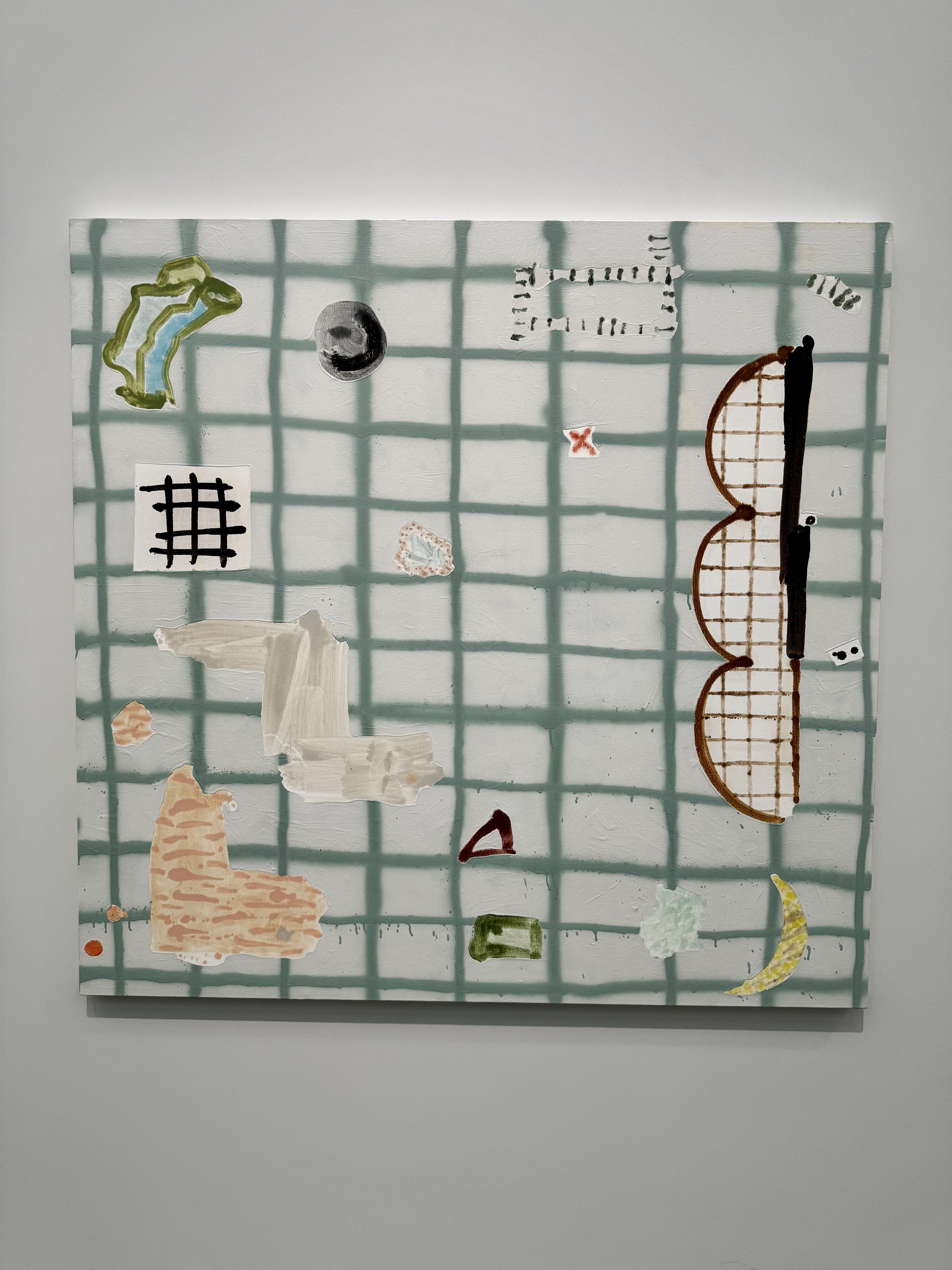
The piece invited me in quietly. It looked like a series of miniature paintings, each with intricate details and subtle variations. At first it felt playful and fun. As I looked closer, the structure began to feel peaceful.
The squares were imperfect and deliberate. Their details seemed to come from the small pleasure of making marks. Looking at them, I could see how often my own perfectionism kills an idea before it has a chance. Beyond the visual pleasure, Morris's piece reminded me that the process itself can make me happy. The joy was in the little details and the room to play inside the framework.
Her work changed how I think about structure. When I use it well, structure gets me past the fear of a blank canvas and gives me a place to start. That was the gift of Morris's piece: the reminder that even a tight space can hold a lot of play.